WeatherSys Admin
A collaborative project from Arcade Commons and partially funded by the 2024 Brooklyn Arts Council Grant, WeatherSys Admin is an arcade cabinet-style multimedia sculpture that features at least six weather-related game and experience projects that are affected by real-time weather API data. In residency at the Museum of the Moving Image in Astoria, NY from July 24, 2025 to January 4, 2026. Now currently in residency at Wonderville's indie arcade gallery.
Planning
Concept Proposal
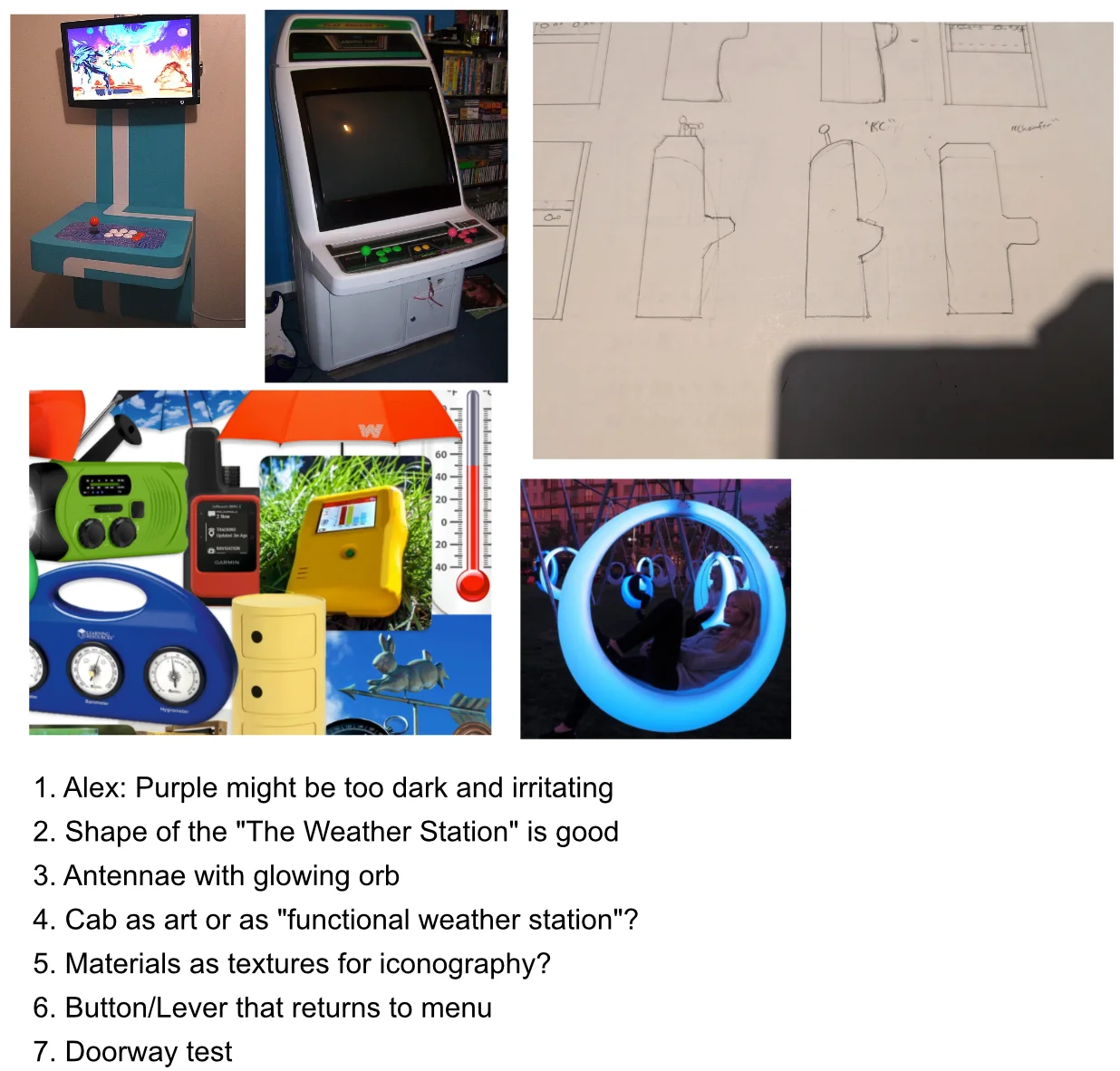
WeatherSys Admin was originally pitched in a grant proposal written by Allen Riley on behalf of Arcade Commons as a “weather machine” concept. The premise was simple: the games in the arcade cabinet should all be affected in some way by calls to remote weather APIs. There were no more constraints given, allowing developers and designers to run wild with the ways in which they could express this idea.
Aesthetic Planning
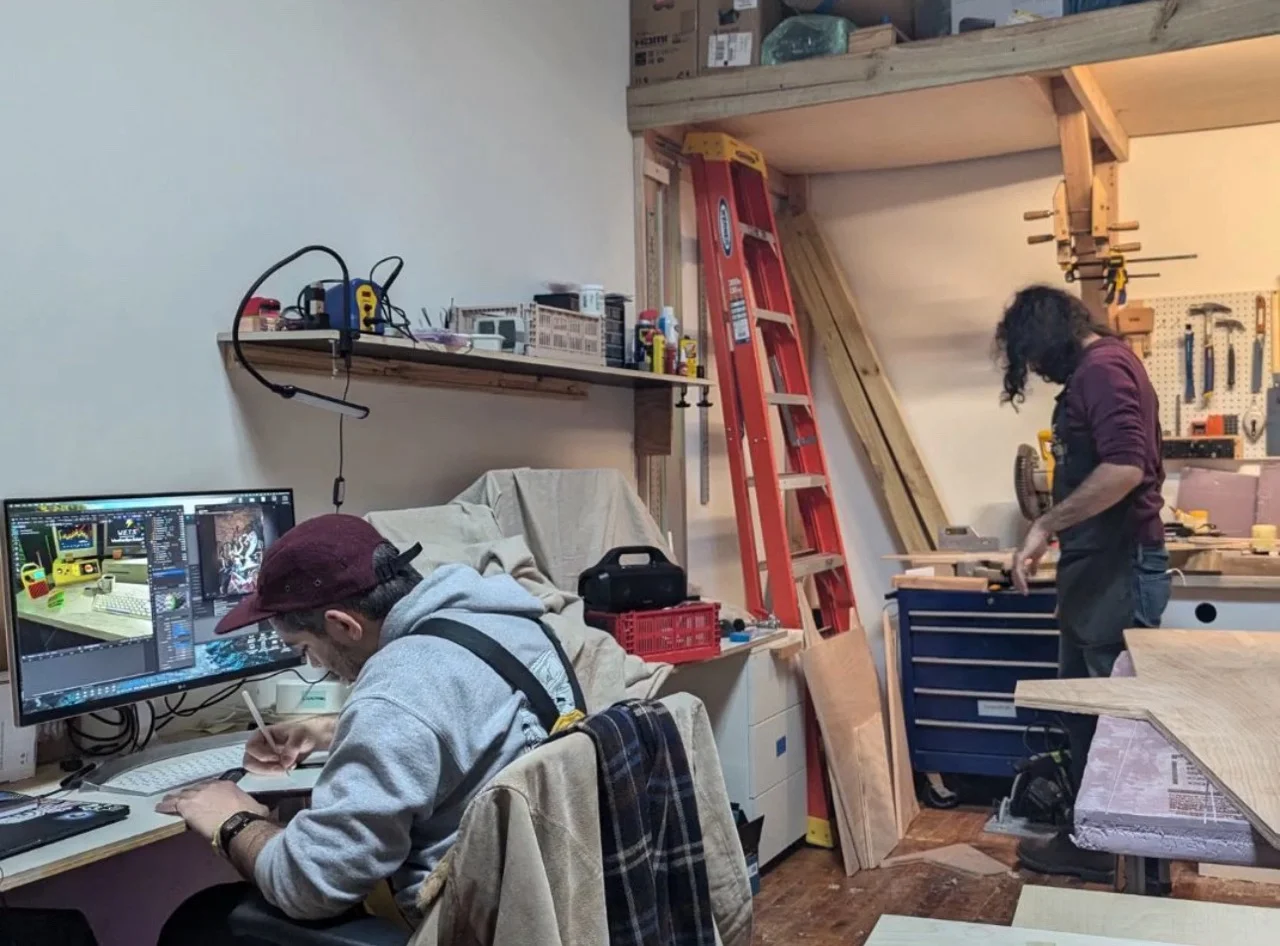
I jumped on in the summer of 2024 when I volunteered for the position of Lead Designer. From here on out, I was heading the artistic planning of how the cabinet was going to be communicating the aesthetic. Along with the core team, Lead Fabricator Alex Panait, Lead Technician Steve Faletti and Project Manager Mark Kleback, we began to hold meetings to discuss the aesthetic approach.
While we were able to acknowledge the obvious pull towards what I like to call, “Climate Dismalism,” we decided collectively that we wanted the story of the cabinet to lean towards an action-based, somewhat solar-punk concept. I wanted the cab to approach a sense of possibility and positivity based on the existing scientific and social data surrounding weather and modern, educated climate verbiage. The team settled on a “robust, tough, but simple” aesthetic direction.
Since this was a standing arcade-style machine, I wanted the user to feel like they were approaching a terminal that would allow them to affect something as grand as the weather with simple controls. I studied some of my favorite media control schemes and was influenced deeply by aesthetic concepts such as Nedry’s desk from Jurassic Park (1993), Ellie’s control room for extra-terrestrial listening from Contact (1997) and the retro-future aesthetics of the human space ships from Alien (1979).
Designing the Arcade Cabinet Aesthetic
Thinking of the future, I began to wonder, “What kinds of aesthetic would mark ‘success’ in the symbiosis of man and nature?
What would it look like if our technology were to coexist kindly with nature?
What kinds of shapes invoked safety and long-term security in my life?
Growing up in a lower-middle class, single-parent home, I developed a fondness and appreciation for things that were both modular, frugal and dependable while still feeling like they offered a sense of uniqueness. I started thinking about children’s toys and how modern plastics technology shows us that rounded shapes and beveled edges seem like they are what will last the longest. One standout design influence was brought up by Steve Faletti in form of the Garmin inReach. It was doing so much of what we were trying accomplish already with a product design that I now genuinely admire. In looking at other common disaster radios and emergency communication devices, I noticed that there was certainly an aesthetic language built around dependability.
When I design, I usually like to just keep playing until something starts to feel right. I knew from the start that I wanted saturated and robust colors with a somewhat retro-future aesthetic. I played with vector graphics until I started to feel the excitement of an idea headed in the right direction. Working with Arcade Commons, we have a long history of unique and art-forward indie arcade cabinets and I wanted to make an arcade cabinet that would stand out even amongst our extremely diverse collection.
I used Blender to quickly sculpt shapes and flesh out design concepts for a couple weeks. Finally, one night while eating Brooklyn’s finest pizza (you’ll have to ask me in person) and arguing about buildability details with lead fabricator Alex Panait, we knew we had in front of us a design that we were going to carry to the end.
Construction
The Launcher: “Welcome to W.E.T.S.”
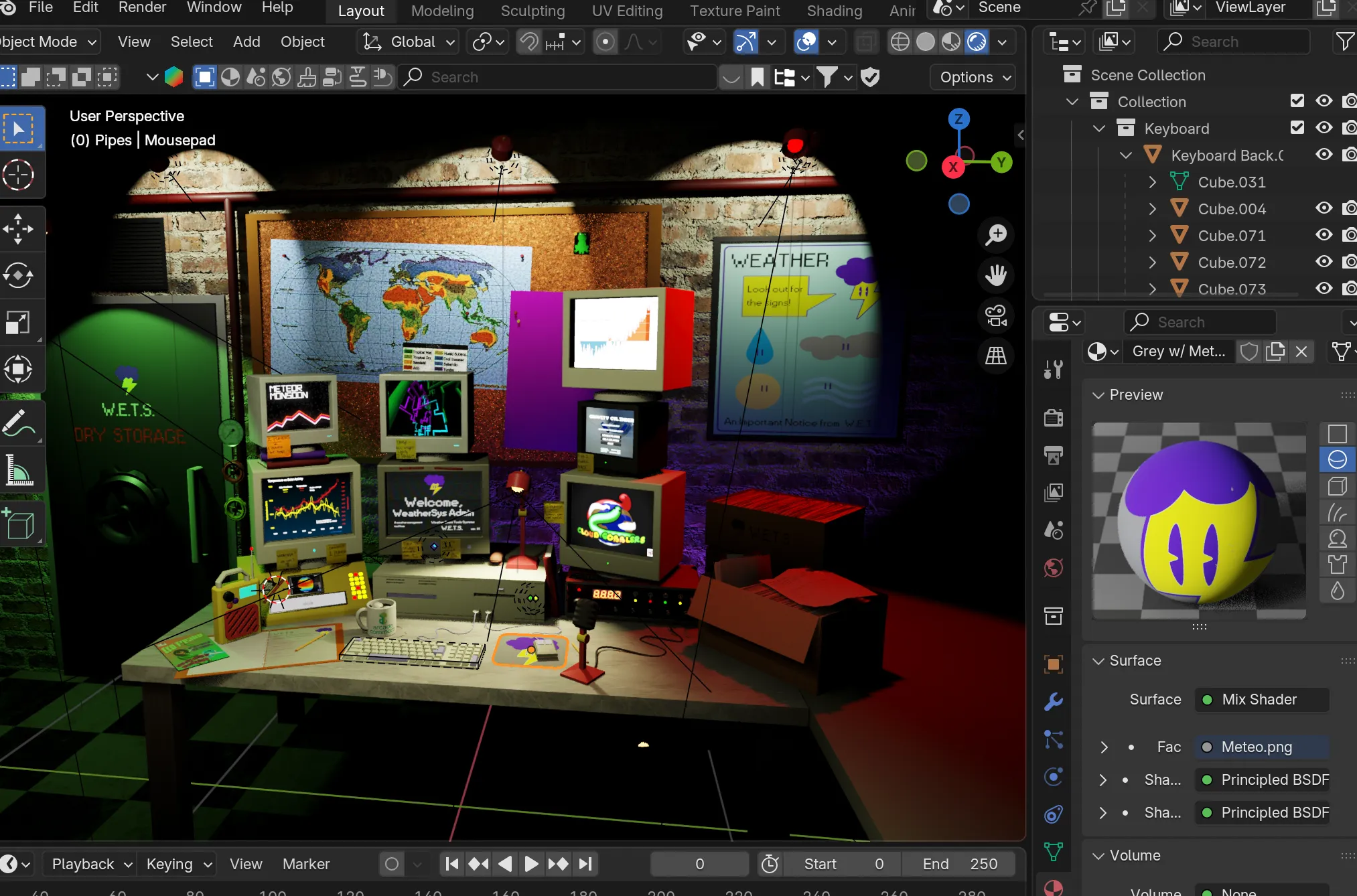
Since this was a standing arcade-style machine, I wanted the user to feel like they were approaching a terminal that would allow them to affect something as grand as the weather with simple controls. I studied some of my favorite offices and control panels and was influenced deeply by aesthetic concepts such as Nedry’s desk from Jurassic Park (1993), Ellie’s control room for extra-terrestrial listening from Contact (1997) and the retro-future aesthetics of the human space ships from Alien (1979).
I wanted my launcher design to feel at home within the cab design, so I created both skeuomorphic elements to blend with the eerie and familiar office setting of the fictional NGO, W.E.T.S. (Weather Event Tools Systems) In Affinity Designer, I created tons of assets that were then imported into my scene in Blender where the entire project lived. I used my iPad to draw assets, Blender to model 3D and Affinity Designer to create nearly all of the art visible in the launcher. The notes and the a few other objects were hand-drawn and the photographed to use as textures in the 3D scene. This was one of my favorite tricks to mix the low poly world with a touch or realism.
Building the Cab
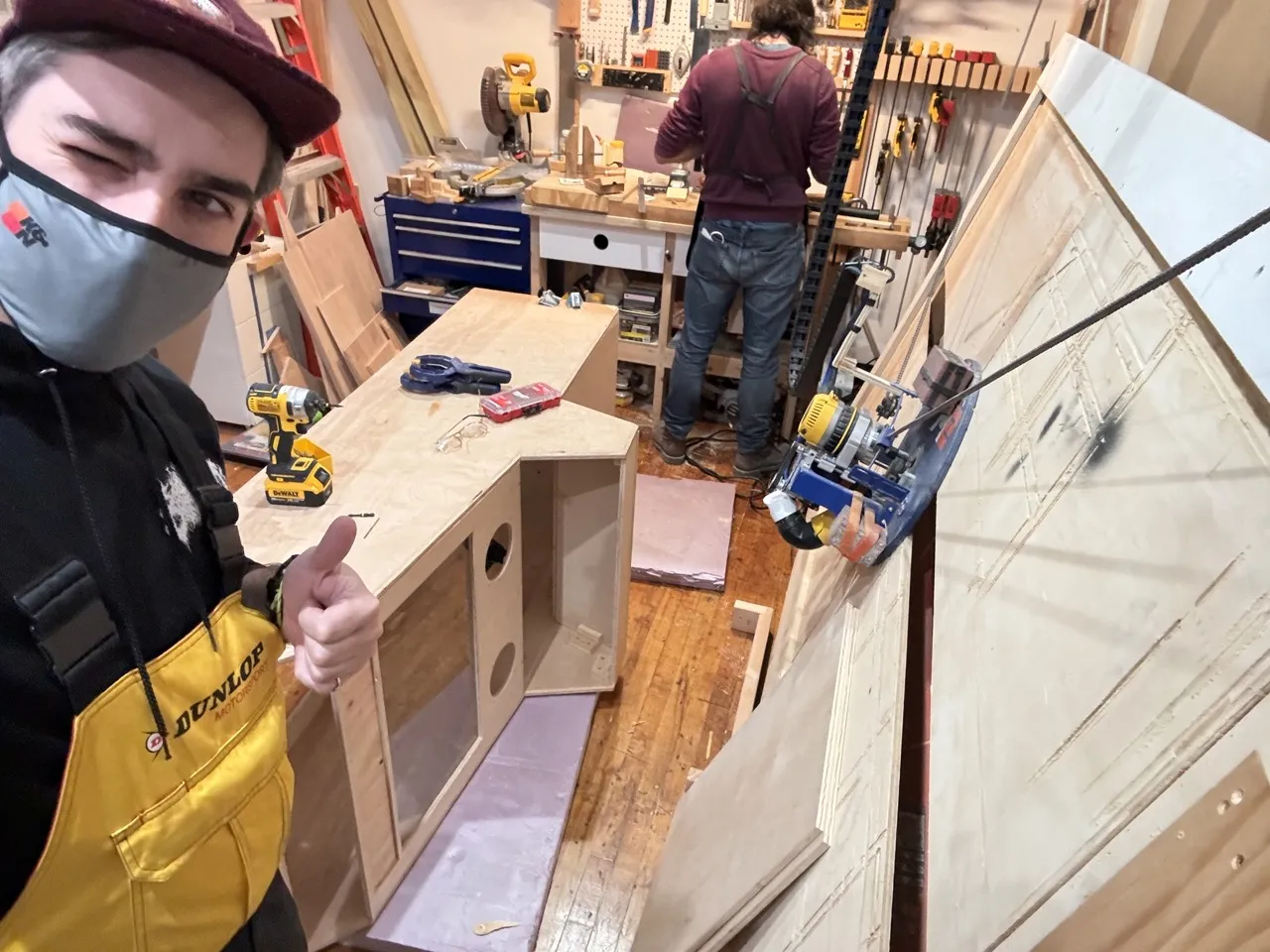
For this part, Lead Designer Alex Panait and I worked closely to make the 3D render that I created into reality. Lead Technician Steve Faletti took my original design from my blender model and created a CAD version in Fusion 360. He held a class to teach some CAD basics that dramatically accelerated my own learning and understanding of how CAD and Fusion 360 are supposed to work given my background in Blender. We began the planning process and I supported Alex in the woodworking process. The sides were cut out in the CNC machine that lives in the Arcade Commons shop where Alex and I essentially lived during October and November of 2024.
We had plenty of help from some talented friends when it came to painting, cutting the acrylic pieces and finding the parts necessary to create the build we saw in my Blender file. Most of the plastic pieces on the cab I was able to design and build in Fusion 360 with my newfound CAD knowledge and my handy but dated Prusa MK3 printer!
Wires and Finishing Touches
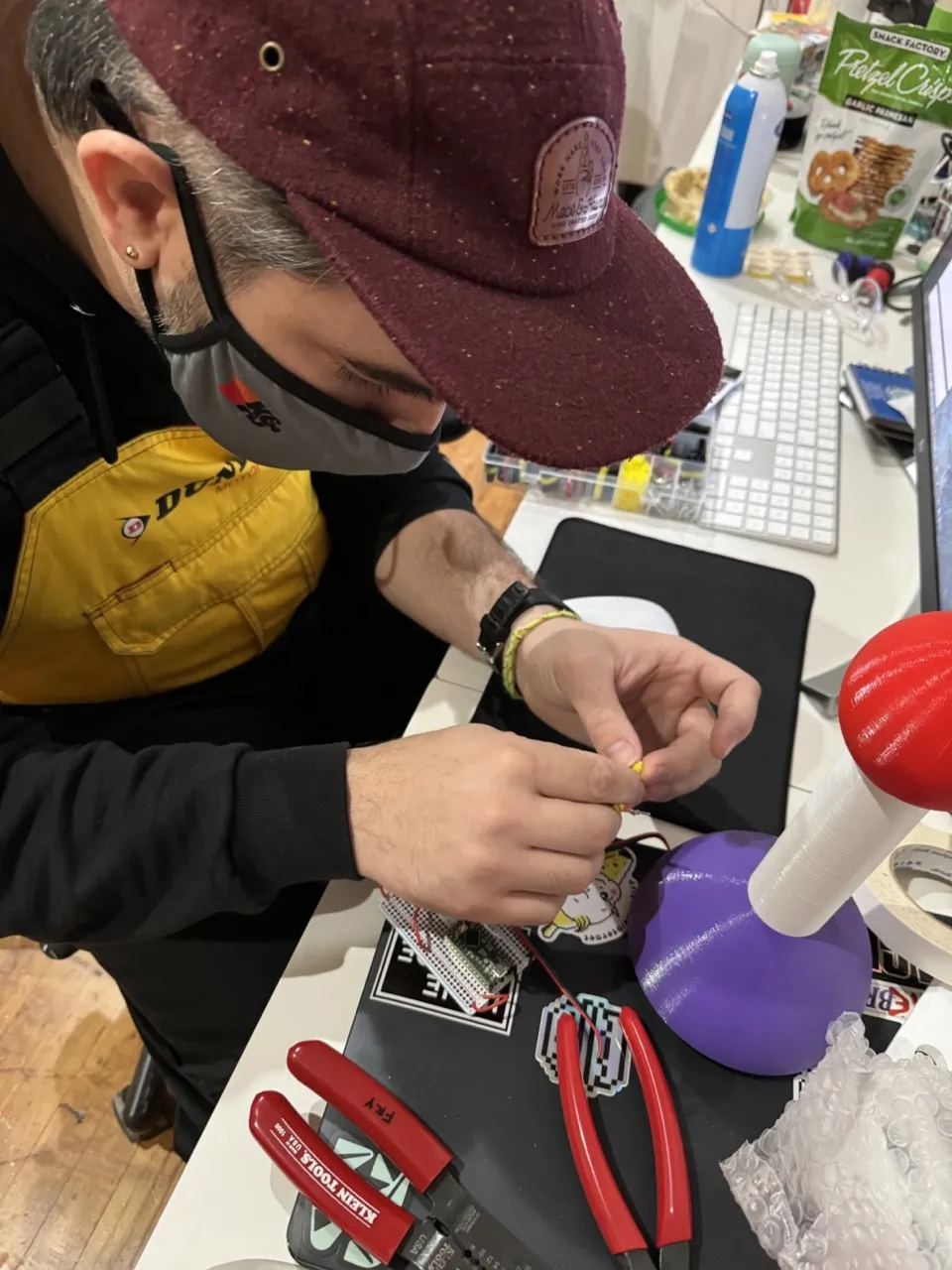
Mark Kleback and Steve Faletti took charge of wiring up the control systems for the arcade cab and helped us come up with the two-player, two-button, spinning wheel setup using a Teensy and the Ultimarc encoder used on Nick Santaniello’s game, HOVERBURGER. The antenna on top of the cab also contains a microcontroller and was programmed by Mark to pulse at certain intervals.
We used LED strip lights with a laser-cut acrylic cutout of the project’s wordmark (thanks to Shy Ruparel) to create the backlit effect on the marquee. I wanted it to shine like code on a dark backdrop without exposing any wires. Cutting midway into the acrylic was perfect for this effect. We used Mark’s tried and true amp system to wire up the speakers. Alex created an ingenious system for mounting the monitor and an incredibly simple method for opening the cab from the front using the edges of the console as it’s own hinge. I designed and 3D printed plenty of small parts and pieces including handles, wire clips and clamps.
Welcome, WeatherSys Admin!
The Experience
Featuring six games by Robysoft, Emma Technology Cooperative, Carpet Dime Studios, Saga City Games, Kenji Jones, and Aaron Blake.
WeatherSys Admin is an interactive arcade cabinet that casts visitors as new hires at W.E.T.S. (Weather Event Tools Systems), a fictional non-governmental organization (NGO) tasked with responding to global ecological crises through surreal but routine deskbound assignments. Installed at a fictionalized weather response terminal, players are surrounded by CRT monitors, blinking buttons, and labeled inputs offering access to six distinct tools, each a self-contained video game, addressing phenomena ranging from meteor storms to tactical turkeys.
Drawing on live weather data throughout gameplay, the six games reflect the tension between procedural bureaucracy and the chaos of planetary change. As in many NGOs, the scope of the crisis is enormous, while the tasks at hand remain curiously clerical: submitting Weather Event Reports, deciphering sensor readings, and adhering to protocol. The games alternate between urgency and tedium, positioning climate response as a loop of reactive, diligent, and sometimes confusing micro-interventions.
Each game integrates real-time environmental data to generate dynamic, location-based features at least once per day.
The Games
Meteor Monsoon transforms rainfall data from cities around the globe into the core mechanic. Each day, players must protect a new city, determined by actual precipitation and wind speed levels, redirecting torrents of rain to fuel water cannons and fend off meteor strikes and alien invasions.
Cloud Gobblers draws from the National Oceanic and Atmospheric Administration’s (NOAA) GOES-19 satellite imagery to generate a shifting cloud-covered Earth as its playfield. In a head-to-head, snake-style competition, players maneuver avatars across live cloud formations, gaining length by consuming meteorological data rendered as interactive terrain.
Weather or Not is a globe-spanning minigame collection built around past weather disasters. Drawing on multiple real-time weather data sources, it maps historical climate events to locations on a virtual Earth. Players travel by weather balloon, attempting to resolve absurd crisis scenarios with questionable tools and cheerful ineptitude. The game is framed by a catchy theme song and an endearing tone that contrasts playfully with the scale of planetary distress.
Gravity Cylinder adapts the speculative architecture of the O’Neill space cylinder into a fast-paced infinite runner. Live weather data from ZIP Code 11106 (MoMI’s location) determines visibility and scoring conditions: rain or snow triggers difficulty multipliers, while storms and fog obscure the player’s field of vision. Players accelerate through the cylinder to rack up high scores, dodging obstacles in a climate-modulated landscape that merges outer space aesthetics with Earthly meteorology.
Turkey Extinction Accelerator is an enigmatic work in which droplets of water, sourced from real-time rainfall data, fall across a foreboding and indecipherable interface. Turkeys appear without explanation, their role in the system unclear, neither fully symbolic nor entirely literal. The game offers no explicit goals or feedback, cultivating an atmosphere of ambient threat and procedural detachment. Its opacity feels intentional, echoing the bureaucratic ambiguity at the core of WeatherSys Admin itself.
Tango begins when one player reaches out to another, triggering a lopsided dance between two cloud-haired figures. Their noodle-like arms flap and drift with each movement, sometimes coordinated, often chaotic. With real-time weather variables unknown, it could only be guessed whether it’s a dance for rain or just an awkward duet.
Let's work together!
I love building things: organizations, 3D, artwork and music! Get in touch with me below to start making great stuff.